St Augustines Church
St Augustines Church
A restoration of St Augustine’s Church for the Order of St Augustine which strips back the layers of paint and decoration to reveal the original volume and features of the church more clearly
An unconventional method of warming the church has been incoporated which seeks to reduce energy consumption whilst maintaining comfort and reducing the visual impact of the heating emitters insider the space.


The church was previously heated by blowing warm air around the room using electric powered fans housed inside wall mounted convectors.
To heat the church fully by convection, a large volume of room air and the heavy masonry walls needed to be warmed. Warm air heating systems promote internal air currents. The less dense heated air naturally rises out of the occupied zone up to the ceiling and as this air cools, it will drop back down forming downdraughts.
To maintain comfort in the room, the heating system needed to operate continuously until the whole volume of air in the room is warmed. Any heater that attempts to heat the whole air volume will use large amounts of energy in the process. Keeping the warm air heaters on for long periods of time did not suit the occupancy pattern of the Church.

We designed a system that prioritises radiant heat transfer which avoids directly heating the whole volume of air inside the church. Copper pipes are embedded within the base of all masonary external walls. Heated water is circulated through the pipes and the walls are continuously heated 24 hours a day during the heating season.


Pipe routes made with a wall slotter machine
Copper pipes at high and low level below windows
Spacer blocks were attached to pipes to maintain 10mm plaster cover


Checking the installation
Pipes covered bonding & plaster
Pipes concealed within walls


Initial testing
The embedded pipework is visible through an infrared camera

The wall tempering system was designed to provide a base level of comfort during general use with the heat generated by the occupants contributing to a warmer envionment for times when the church is busy for events and popular services.

New primary servicing routes were incorporated into existing floor trenches previously used to route pipework for the original gas lighting. These service trenches were re-formed using the collection buckets from sections of standard Aco slot drains butted together. A new timber accessible cover was applied to contrast with the original floor.


- Matching dimensions of the existing floor trench
Standard Aco drainage castings
Aco trench installed

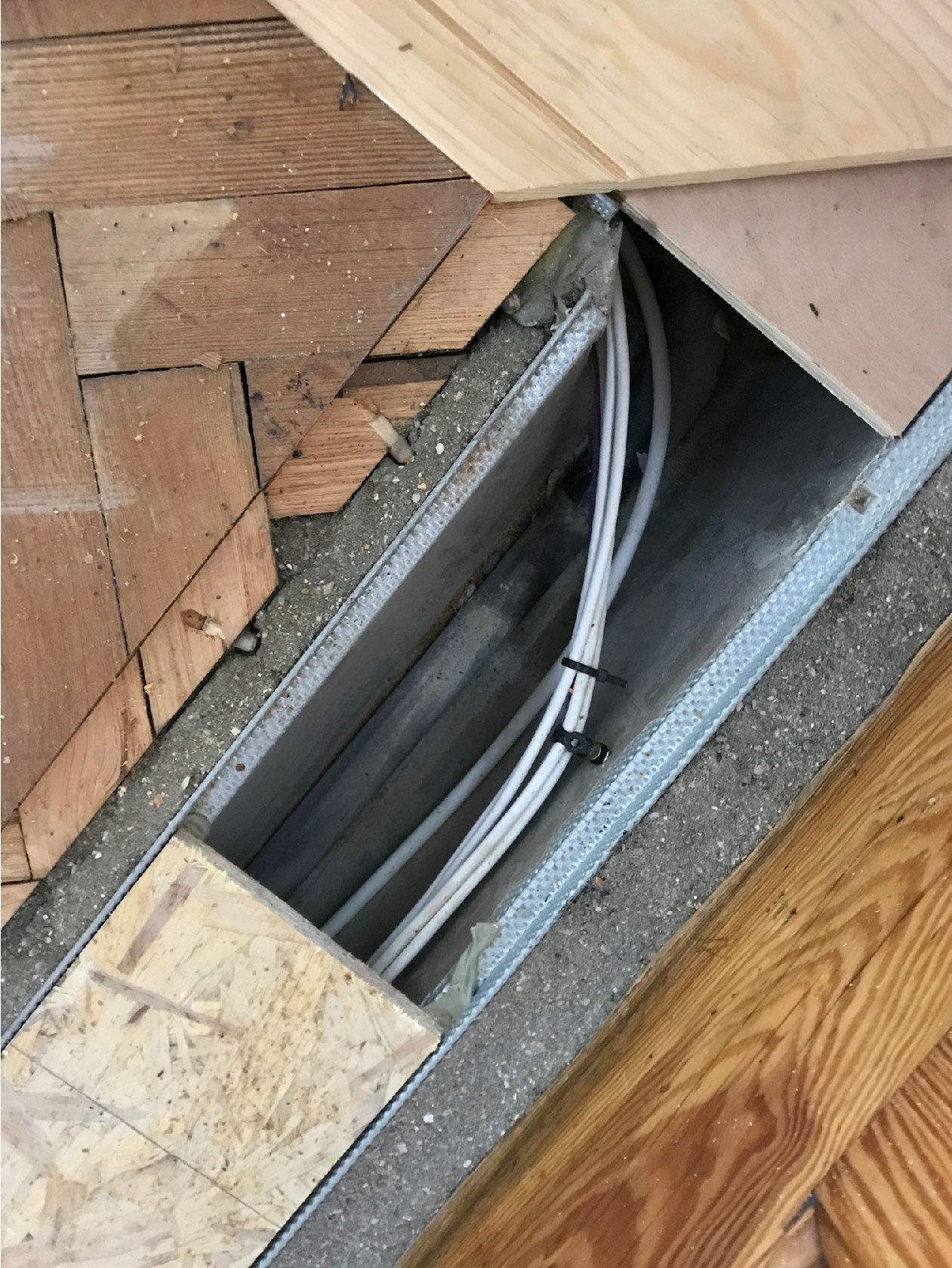

Pipework laid within trench
Cables routed with trench
Energy Data
Existing Church
32kWh/m3 year
Refurbished Church
15kWh/m3 year
Existing Church
233kWh/m2 year
Refurbished Church
112kWh/m2 year

RIBA National Award 2018
RIBA London Award 2018
President's Award UK Church Architecture Awards 2019